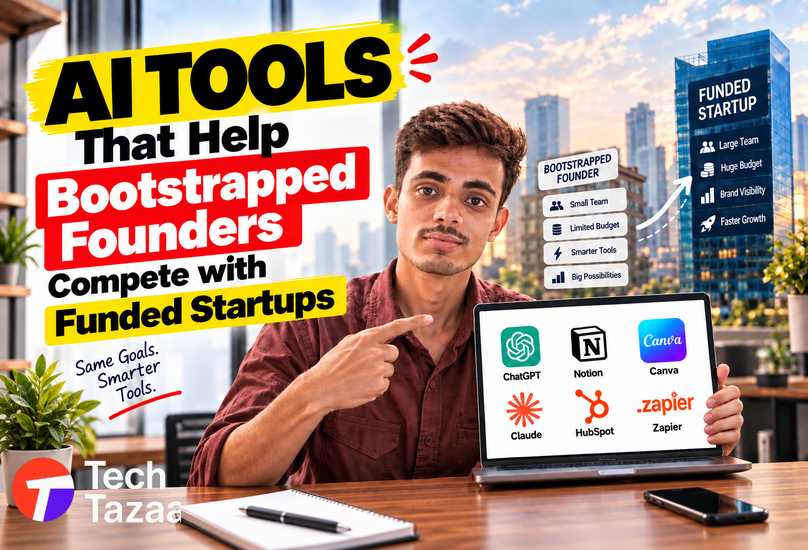

Starting a business without external funding is not easy. Bootstrapped founders often work with small teams, limited marketing budgets, and fewer technical resources. Meanwhile, venture-backed startups can spend heavily on product development, hiring, advertising, and customer acquisition.
But does having less funding mean a startup cannot compete?
Not necessarily. Artificial intelligence (AI) is changing how businesses operate. Founders can now use AI tools to research markets, build websites, develop products, create marketing campaigns, generate leads, and automate daily operations without hiring large teams.
The right AI tools for bootstrapped founders can reduce repetitive work, control operating costs, and help small businesses move faster. Instead of spending money on every business function, founders can use AI to handle specific tasks and focus their time on customers and business growth.
Let’s look at the AI tools that can help bootstrapped founders compete with funded startups in 2026.
Why Bootstrapped Startups Need AI Tools to Compete with Funded Companies
Running a startup with limited resources requires careful planning. Founders must manage several responsibilities while keeping expenses under control.
AI tools can help address some of these challenges.
Limited Budgets and Smaller Teams
A funded startup may have separate employees for marketing, sales, development, customer support, and operations. A bootstrapped founder might handle several of these responsibilities alone.
AI tools can assist with content writing, customer communication, research, and administrative tasks. This reduces the amount of repetitive manual work and can lower the need for outside support for routine activities.
Faster Execution Without Hiring More Employees
AI can help founders complete everyday tasks faster. For example, they can generate a first draft of a marketing email, prepare a product requirement document, summarize customer feedback, or create a website prototype.
However, AI-generated work still needs human review. Founders remain responsible for business decisions, quality checks, and customer relationships.
Smarter Business Operations
AI automation tools for startups can connect different business applications and move information between them.
For example, when someone submits a website enquiry, an automated workflow can add the contact to a CRM, notify the sales team, and send an acknowledgement email.
This allows a small team to manage routine operations without handling every step manually.
12 Best AI Tools That Help Bootstrapped Founders Grow Their Startups
The best AI tools for entrepreneurs depend on their business requirements. Some help with research, while others support development, marketing, sales, and customer service.
Here are tools worth considering.
1. AI Tools for Research and Business Planning
ChatGPT: Founders can use ChatGPT for business planning, brainstorming, competitor research, content creation, customer personas, and marketing strategies.
Claude: Claude can assist with long-form writing, document analysis, coding, and product planning.
Perplexity: Perplexity helps users research topics and find information with linked sources.
Practical use: Before launching a product, ask an AI assistant to help identify customer problems, list potential competitors, and prepare interview questions. Verify important information using original sources and customer conversations.
2. AI Tools for Website Development and Product Building
Lovable: Lovable helps users create applications by describing what they want in natural language. It can generate interfaces, data structures, and application logic.
Cursor: Cursor is an AI-powered code editor that helps developers write, understand, and modify code.
Bolt.new: Bolt.new helps users create and test web application prototypes through prompts.
These tools can help founders build landing pages, internal dashboards, MVPs, and early product versions.
However, an AI-generated application still needs testing. Authentication, payment processing, security, database permissions, and performance should be reviewed before launching a product to paying customers.
3. AI Tools for Marketing, SEO, and Content Creation
Marketing is another area where small startups can use AI to manage limited resources.
Jasper: Jasper supports marketing content creation, campaign planning, and brand-focused writing.
Canva: Canva helps founders create social media graphics, presentations, advertisements, and other visual content.
Surfer SEO: Surfer provides content optimization features for SEO-focused writing.
ChatGPT: Founders can use ChatGPT for blog outlines, keyword research assistance, ad copy, email campaigns, and social media calendars.
For example, a founder can use AI to prepare a monthly content calendar, draft blog posts, create advertising variations, and develop social media captions.
AI can reduce content production time, but it should not replace original research, editing, or an understanding of customer search intent.
4. AI Tools for Sales and Lead Generation
Finding potential customers is one of the biggest challenges for early-stage businesses.
HubSpot: HubSpot provides CRM, marketing, and sales tools to manage customer relationships and sales activities.
Apollo.io: Apollo.io supports B2B prospecting and sales intelligence.
Clay: Clay helps teams research prospects, enrich contact data, and build sales workflows.
Founders can use these platforms to identify potential customers, organize leads, personalize outreach, and manage follow-ups.
For better results, define your ideal customer profile before building prospect lists. Avoid sending generic bulk messages, and follow applicable privacy and marketing rules.
5. AI Tools for Workflow Automation
Zapier: Zapier connects different applications and automates repetitive business tasks.
n8n: n8n supports custom workflows and AI-powered automation.
Notion: Notion helps teams manage projects, documents, tasks, and internal information.
For example, a startup can connect website forms with its CRM and email platform. Whenever a customer submits a form, the system can save the details and notify the responsible person.
6. AI Tools for Customer Support and Communication
Intercom: Intercom provides customer messaging and AI-assisted support features.
Tidio: Tidio offers website chat and automated customer support.
Fireflies.ai: Fireflies.ai helps record, transcribe, and summarize meetings.
These tools can help small teams answer common questions, organize customer conversations, and reduce time spent preparing meeting notes.
Keep a human support option available for complaints, billing problems, and questions that automated systems cannot resolve.
7. AI Tools for Analytics and Business Reporting
PostHog: PostHog provides product analytics, user behaviour tracking, and funnel analysis.
Google Analytics 4: Google Analytics helps track website traffic, user activity, and conversions.
Microsoft Power BI: Power BI helps businesses create reports and dashboards.
Founders can use analytics tools to understand where visitors come from, which pages generate enquiries, and where customers leave the conversion process.
The goal is to make decisions using actual business performance rather than assumptions.
Free AI Tools for Bootstrapped Founders on a Tight Budget
Not every startup needs paid AI subscriptions from day one. Many platforms provide free plans or limited free usage.
Some options include:
- ChatGPT: Business research, writing, and brainstorming.
- Claude: Writing, document assistance, and general tasks.
- Perplexity: Online research and source discovery.
- Canva: Basic graphic design and visual content.
- Lovable: Starting application projects with limited free credits.
- Bolt.new: Testing AI-powered application development.
- Google Analytics 4: Website analytics.
Free-plan limits and features can change, so check the official websites before choosing a tool.
A practical approach is to start with free plans, identify the tasks that consume the most time, and upgrade only when a paid feature provides a clear business benefit.
How AI Tools Help Bootstrapped Founders Compete with Funded Startups
AI does not automatically make a small startup equal to a funded company. However, it can help close certain operational gaps.
Reduce Operational Costs
Founders can use AI for first drafts, meeting summaries, research, basic design work, and repetitive administration. This can reduce external spending on routine tasks.
Launch Products Faster
AI development tools help founders create prototypes and test ideas before investing heavily in development.
For example, a founder can create a basic customer dashboard, show it to potential users, collect feedback, and improve the product.
Run Marketing Campaigns with Smaller Budgets
AI can assist with SEO content, email marketing, social media posts, and advertising copy.
Founders can test different messages and landing page variations without needing a large marketing department.
Automate Lead Generation and Follow-Ups
CRM platforms and automation software help organize enquiries, assign leads, and schedule follow-up activities.
This reduces the chance of losing potential customers because someone forgot to respond.
Make Decisions Using Business Data
Analytics platforms help founders track website visitors, customer acquisition, conversion rates, and product usage.
These numbers can help identify which activities deserve more attention and which ones are not producing the expected results.
How to Build a Low-Cost AI Tech Stack for Your Startup
Instead of purchasing every popular AI subscription, build a small technology stack around your actual business needs.
For solo founders:
- ChatGPT or Claude for research and writing.
- Lovable or Cursor for product development.
- Canva for design.
- Zapier or n8n for automation.
- Google Analytics 4 for website tracking.
For startups with 2–5 employees:
- AI assistant for daily tasks.
- CRM for sales management.
- AI coding tools for product development.
- Marketing tools for content production.
- Automation software for internal workflows.
For growing startups:
- Customer support automation.
- Sales prospecting and CRM.
- Advanced product analytics.
- Marketing automation.
- Internal knowledge management.
How Much Does an AI Startup Tech Stack Cost?
The following figures are planning examples, not verified subscription prices.
Startup setup | Suggested monthly budget |
Free AI stack | ₹0 |
Basic AI stack | ₹2,000–₹5,000 |
Growing startup stack | ₹5,000–₹15,000 |
Actual expenses depend on subscription plans, usage, taxes, and the number of users.
Practical Ways to Use AI Tools in a Bootstrapped Startup
Consider a founder launching a B2B software company.
First, they can use ChatGPT and Perplexity to research the market and prepare customer interview questions. Next, they can use Lovable to create an early product version and Canva to prepare marketing materials.
Once the website is live, HubSpot can manage enquiries, while Zapier can connect website forms with the CRM.
Finally, Google Analytics 4 can track website activity and conversions.
This creates a working process across research, development, marketing, sales, and analytics without requiring a large internal team.
The founder still needs to speak with customers, test the product, review AI-generated work, and make business decisions.
Common Mistakes Bootstrapped Founders Should Avoid When Using AI
Buying too many subscriptions: Multiple tools with similar features can increase monthly expenses. Start with a small stack.
Depending completely on AI-generated content: Review facts, edit the writing, and add original examples and customer experience.
Ignoring data privacy: Avoid entering sensitive customer or business information into tools without checking their data policies and security settings.
Automating unclear processes: First understand how a task should work. Then automate the repetitive steps.
Choosing tools because they are popular: Select software based on your requirements, budget, integrations, and actual results.
The Future of Bootstrapped Startups in an AI-Driven Business Environment
AI is making software development, marketing, research, and business automation more accessible to small companies.
AI agents and connected workflows may also help founders manage tasks across multiple applications. However, human judgement remains necessary for product decisions, customer relationships, quality control, and business strategy.
The startups that get practical results from AI will not necessarily be those using the most tools. They will be the ones that understand their customers, choose suitable software, and use automation to solve real business problems.
Frequently Asked Questions About AI Tools for Bootstrapped Founders
What Are the Best AI Tools for Bootstrapped Founders?
ChatGPT, Claude, Perplexity, Lovable, Cursor, Canva, Zapier, HubSpot, and Google Analytics 4 are useful options. The right combination depends on whether you need help with research, development, marketing, sales, or business operations.
Can AI Tools Help a Startup Compete with Funded Companies?
Yes. AI can help smaller teams automate repetitive work, build prototypes, create marketing content, and manage customer communication. However, funding still provides advantages in hiring, research, infrastructure, and market expansion.
What Are the Best Free AI Tools for Startup Founders?
ChatGPT, Claude, Perplexity, Canva, and Google Analytics 4 offer options for founders starting with limited budgets. Some development platforms also provide limited free credits.
Can I Build a Startup Without Hiring Developers Using AI?
AI application builders such as Lovable and Bolt.new can help create prototypes and early applications. However, complex products may require professional developers for security, testing, integrations, and maintenance.
How Can Bootstrapped Founders Use AI for Marketing?
Founders can use AI for keyword research, blog writing, SEO planning, advertising copy, social media content, and email campaigns. Human editing and performance tracking remain necessary.
How Much Does It Cost to Run a Startup Using AI Tools?
It depends on the tools, subscription plans, and usage. Founders can start with free plans and gradually purchase subscriptions when the business requires additional features.
Which AI Tools Are Best for Solo Entrepreneurs?
ChatGPT for research, Canva for design, Lovable for app building, Zapier for automation, and Google Analytics 4 for website tracking are useful starting options.
Can AI Replace Employees in a Small Startup?
AI can assist with repetitive tasks such as drafting emails, preparing reports, and answering common questions. It does not remove the need for human judgement, specialist knowledge, and customer relationships.
How Do I Choose the Right AI Tools for My Startup?
Identify your biggest operational challenges first. Compare tool features, pricing, integrations, security, and ease of use. Test free plans before committing to paid subscriptions.
Conclusion: Build a Lean Startup with the Right AI Tools
Competing with funded startups does not always require matching their budgets or hiring the same number of employees. Bootstrapped founders can use AI tools to manage research, product development, marketing, sales, customer support, and business operations with fewer manual tasks.
Start with a few tools that solve your biggest problems. Track the time saved, costs reduced, leads generated, and improvements in customer experience. Add more software only when your business needs it.
You do not need dozens of AI subscriptions to build a successful startup. You need the right tools, a clear business plan, and a strong understanding of your customers.
Which AI tools are you currently using to run your business? Share your experience in the comments and help other bootstrapped founders find practical ways to grow.